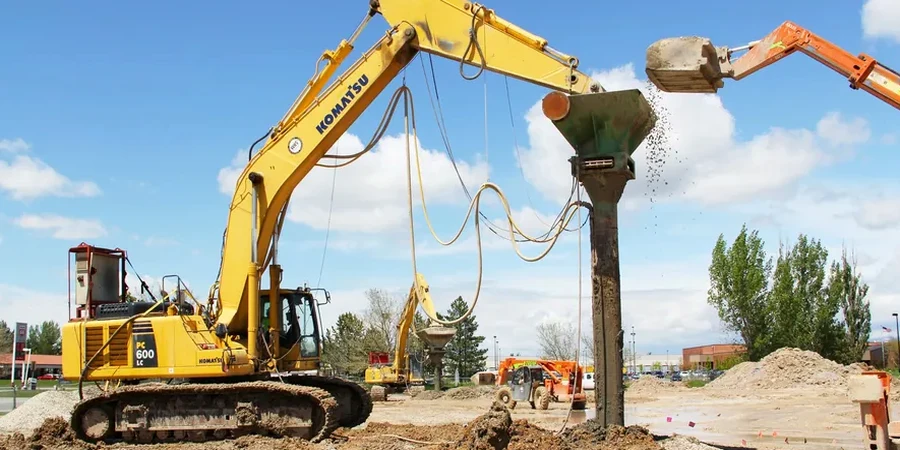
Vibrocompaction design in Sunnyvale must comply with IBC 2021 and ASCE 7-22 seismic criteria, particularly for sites underlain by loose sandy fills from historic orchard grading. The city's proximity to the San Andreas and Hayward faults imposes high liquefaction potential, making deep densification a common requirement. Before designing the vibrocompaction pattern, we typically run a dilatometer test to profile lateral stress changes with depth, and a MASW survey to map shear-wave velocity zones. This data helps us define probe spacing and energy levels needed to reach target relative densities of 70% or more in the upper 12 meters.
Vibrocompaction in Sunnyvale typically achieves relative densities above 70% in sandy fills, reducing liquefaction-induced settlement by 50–60% under MCE events.
Method and coverage
Sunnyvale's subsurface typically consists of 6 to 12 meters of loose to medium-dense silty sands (SM-SP) underlain by stiff clay (CH) of the Bay Mud sequence. Groundwater sits shallow, between 1.5 and 3 meters, which reduces effective stress and amplifies settlement risk under seismic loading. Our vibrocompaction design addresses three key parameters:
Vibrator frequency tuning to avoid resonance with adjacent structures — common in dense residential zones near El Camino Real.
Backfill material selection using clean, well-graded sand (CU > 4) to avoid clogging of the vibro-probe tip.
Post-treatment verification via CPT soundings and plate load tests at intervals of 10 to 15 meters.
We also integrate CPT profiling to confirm density gain after compaction, a method widely accepted by local building departments.
Technical reference image — Sunnyvale
Regional considerations
The Mediterranean climate of Sunnyvale brings dry summers and wet winters, but the real risk for vibrocompaction lies in the shallow water table. During heavy rains, groundwater can rise to within 1 meter of the surface, reducing the efficiency of vibratory energy transfer. Loose silty sand layers with fines content above 15% also tend to generate excess pore pressure during compaction, slowing densification and requiring rest periods between passes. In areas near Moffett Park or the Sunnyvale Landfill, buried utility lines and former orchard debris can block probe penetration or damage equipment. A thorough utility survey and test probe program should precede full-scale production.
Desk review of existing boring logs, CPT data, and seismic hazard maps. Includes preliminary probe spacing and energy estimates. Output: feasibility memo with cost range and risk assessment.
02
Vibrocompaction Design & Specification
Detailed design including grid layout, vibrator type, backfill gradation, and post-treatment testing protocol. Delivered as a design report ready for building department submittal.
03
Field Supervision & Quality Control
On-site monitoring of probe insertion, amperage draw, and backfill placement. Real-time adjustment of compaction parameters. Daily logs and final acceptance report.
What is the typical cost of a vibrocompaction design study in Sunnyvale?
The cost for a vibrocompaction design study in Sunnyvale ranges from US$1,580 to US$4,510, depending on site size, number of test probes, and post-treatment verification. Additional testing like CPT or MASW may add 15–25% to the total.
How deep can vibrocompaction reach in Sunnyvale's sandy fills?
Effective depth is typically 8 to 15 meters. Below 15 meters, the Bay Mud clay layer limits penetration. In areas with thick dense sand deposits, depths up to 18 meters are achievable with high-energy vibrators.
Does vibrocompaction work in silty sands with fines content above 15%?
It becomes less efficient. For fines content above 15–20%, pre-treatment wick drains or replacement with clean sand backfill may be needed. A pilot test program using CPT soundings before and after compaction is recommended to verify densification.
What post-treatment testing is required by Sunnyvale building departments?
Most building departments accept CPT or SPT soundings at intervals of 10–15 meters, plus plate load tests at 2–3 locations. The test data must demonstrate relative density above 70% and liquefaction resistance factor greater than 1.1 under MCE shaking.