Sunnyvale sits on alluvial fans and ancient bay deposits, where the water table often drops 15–20 m below grade. That deep phreatic level leaves a thick vadose zone of clay and silt in a state of partial saturation — a condition that triggers volume changes and strength loss under load. We run unsaturated soil analysis in Sunnyvale to capture suction pressures and collapse potential before foundations are poured. This analysis is critical because a dry clay can look competent in a routine boring log yet compress more than 5 cm when wetted. Before we issue a report, we often pair this work with a georadar survey to map hidden moisture pockets, and with cimentaciones sísmicas to verify that the unsaturated layer won't amplify ground motion. The result is a foundation design that accounts for the real soil behavior under seasonal moisture swings.
A dry clay in Sunnyvale can appear hard in a boring log yet compress over 5 cm when wetted — unsaturated analysis catches that collapse risk.
Method and coverage
Sunnyvale receives roughly 400 mm of rain per year, concentrated between November and April — a classic Mediterranean pattern that dries the upper 6–8 m of soil every summer. Our unsaturated soil analysis in Sunnyvale uses suction measurements (tensiometer and filter paper methods per ASTM D5298) combined with SWCC curves to quantify how much strength is lost when the soil rehydrates. The key parameters we determine include:
Matric suction (kPa) at field moisture content
Collapse index from double-oedometer tests
Swelling pressure under constant volume conditions
Unsaturated shear strength parameters (phi_b)
We follow ASTM D2487 for classification and ASTM D698 for compaction reference. For projects near the 237 corridor or the Caltrain tracks, we also run a falla taludes assessment to check that partially saturated cuts remain stable after winter rains.
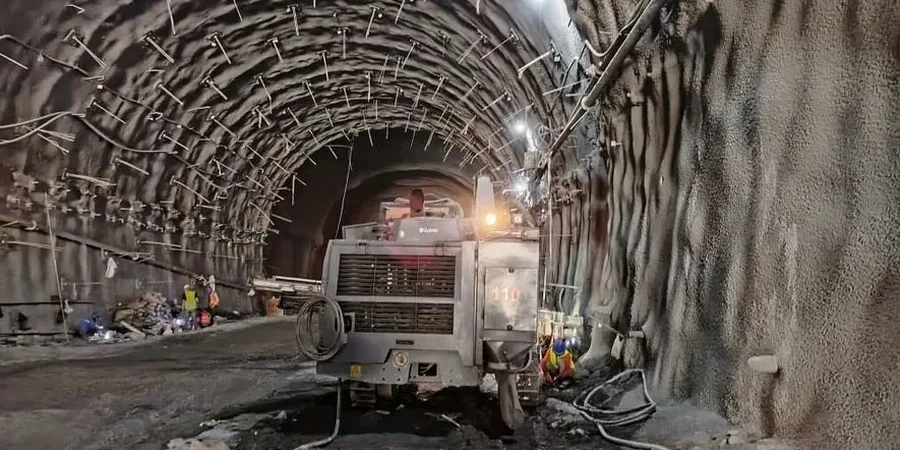
Technical reference image — Sunnyvale
Regional considerations
We use a GDS unsaturated triaxial system with independent pore‑air and pore‑water control — a setup that most labs in the South Bay don't keep in‑house. The machine applies back‑pressure saturation while measuring volume change in both air and water phases. For Sunnyvale's expansive clays, the real risk is that a standard saturated test overestimates strength by 30–50%, leading to undersized footings that settle when the rainy season arrives. Our unsaturated soil analysis in Sunnyvale corrects that error. We also run collapse tests on undisturbed block samples taken from the vadose zone, because a 2 % volumetric strain under a 200 kPa load can crack a slab or tilt a retaining wall.
Full soil‑water characteristic curve from air‑entry to residual saturation using Fredlund & Xing and van Genuchten models. We deliver the fitting parameters for your numerical modeling in PLAXIS or SIGMA/W.
02
Collapse Potential Testing (Double Oedometer)
Paired oedometer tests at natural moisture and saturated condition. We report collapse index per ASTM D5333 and classify severity from negligible to severe. Essential for loess‑like deposits found in the Santa Clara Valley.
03
Unsaturated Triaxial Shear Strength
Controlled suction triaxial tests at three net confining stresses. We determine phi_b and the cohesion intercept, enabling slope stability analysis that accounts for partial saturation. Ideal for cut slopes near Highway 85.
Standards that apply
ASTM D5298 (Filter paper suction measurement), ASTM D6836 (SWCC determination), ASTM D4767 (Consolidated undrained triaxial with pore‑pressure measurement), ASTM D4546 (Swelling and collapse tests)
Top questions
What is the difference between saturated and unsaturated soil analysis?
Saturated analysis assumes all voids are filled with water, which is rare in Sunnyvale's deep vadose zone. Unsaturated analysis measures matric suction and the additional shear strength it provides, plus the collapse or swelling that occurs when the soil wets up. The two approaches can yield bearing capacities that differ by a factor of 1.5–2.0.
How much does unsaturated soil analysis cost in Sunnyvale?
A standard unsaturated characterization (SWCC, collapse index, and one unsaturated triaxial test) ranges from US$1,450 to US$2,820. If only suction measurements and classification are needed, the cost is closer to US$970. Volume discounts apply for multiple test series on the same project.
Which Sunnyvale soil types require unsaturated testing?
The primary candidates are the expansive clay layers (Pleistocene alluvium) and the collapsible silty sands found near the former orchard areas. Both exhibit significant volume change when moisture fluctuates. Soils with a plasticity index above 20 or a dry density below 1.5 g/cm³ should be tested.
How long does it take to get unsaturated soil analysis results?
A typical suite of tests (SWCC, collapse, and one unsaturated triaxial) takes 3–4 weeks from sample receipt. The SWCC itself requires 7–14 days of equilibration at each suction step. We provide interim suction values within 10 days if needed for design decisions.