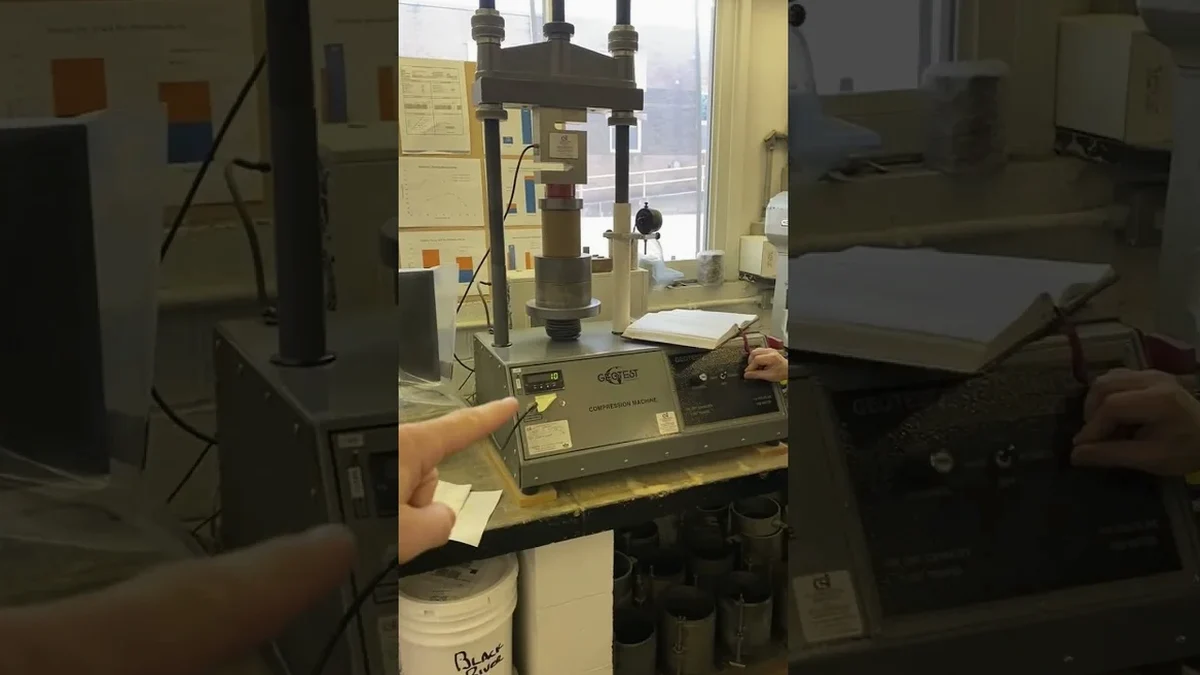
Sunnyvale sits on deep alluvial deposits and the notorious Bay Mud — soft, high-plasticity clays that shift under load. The region's Mediterranean climate, with wet winters and dry summers, causes seasonal moisture fluctuations in these near-surface soils. For any mid-rise building or slab-on-grade project in Sunnyvale, the unconfined compression test (UCS) provides a fast, cost-effective measure of undrained shear strength. Unlike triaxial tests that require confining pressure, UCS is ideal for cohesive soils here, giving engineers a baseline for bearing capacity. Many local geotechnical reports rely on UCS because the Bay Mud behaves as a saturated clay: rapid loading leaves no time for drainage, and the test simulates that exact condition. Before designing shallow foundations, pairing UCS with a study of expansive soils helps anticipate volume changes that crack slabs and tilt footings.
For Sunnyvale's Bay Mud, the unconfined compression test simulates rapid undrained loading — a direct measure of how the soil behaves under a newly poured slab.
Method and coverage
A common mistake among Sunnyvale construction teams is assuming UCS alone validates all clay behavior. The test works best on intact, undisturbed samples of cohesive soil — but only if the sample represents field conditions. Sampling disturbance, storage time, and moisture loss all skew results. The procedure follows ASTM D2166: a cylindrical specimen is loaded axially at a constant strain rate (typically 0.5-2% per minute) until failure. For Sunnyvale's Bay Mud, failure often occurs at 10-15% strain with a distinct plastic bulge. The measured unconfined compressive strength (qu) is used directly for undrained shear strength (su = qu/2). Combining UCS with Atterberg limits clarifies whether the clay is lean, fat, or organic — critical for selecting soil improvement methods like deep soil mixing or preloading.
Technical reference image — Sunnyvale
Regional considerations
Sunnyvale's rapid urbanization from the 1950s onward transformed orchards into office parks and data centers — often without deep geotechnical investigation. Many original structures were built directly on Bay Mud with minimal testing. Today, when retrofitting or expanding those sites, the unconfined compression test (UCS) reveals the true undrained shear strength of the existing foundation soils. A single UCS value that falls below 25 kPa can mean a complete redesign: deep piles, soil replacement, or Improvement. Ignoring the risk of low UCS in Sunnyvale's soft clays leads to differential settlement, cracked structural slabs, and costly post-construction repairs.
Tests on 71 mm diameter undisturbed samples from hollow-stem auger or Shelby tube sampling. Includes moisture content determination, stress-strain curve, and report with qu and su values. Ideal for Bay Mud and clay fills across Sunnyvale.
02
Miniature UCS on Thin-Wall Samples
For smaller-diameter samples (35-50 mm) from hand augers or limited-access boreholes. Uses the same ASTM D2166 procedure with appropriate strain rate adjustment. Suitable for shallow investigations in Sunnyvale's residential lots.
Standards that apply
ASTM D2166/D2166M-16 — Standard Test Method for Unconfined Compressive Strength of Cohesive Soil, ASTM D4220/D4220M — Standard Practices for Preserving and Transporting Soil Samples, IBC 2021 Chapter 18 — Soils and Foundations
Top questions
What is the difference between unconfined compression test (UCS) and triaxial test?
UCS applies no confining pressure — the sample fails under axial load alone. Triaxial tests apply a controlled confining pressure to simulate in-situ stress. UCS is faster and cheaper, but only valid for saturated cohesive soils like Sunnyvale's Bay Mud. Triaxial is needed for granular soils or when effective stress parameters are required.
How much does an unconfined compression test cost in Sunnyvale?
The typical cost ranges from US$340 to US$520 per test. This includes sample preparation, testing, moisture content determination, and a certified report. Volume discounts may apply for projects requiring multiple samples. Contact us for a project-specific quote.
What is the typical unconfined compressive strength of Bay Mud in Sunnyvale?
Bay Mud in Sunnyvale usually exhibits qu values between 20 and 80 kPa. Very soft zones near Moffett Field or the Sunnyvale waterfront can drop below 15 kPa. The test is essential to confirm whether the soil falls within the design assumptions or requires Improvement.
How long does it take to get UCS results in Sunnyvale?
A standard UCS test requires 24 to 48 hours after sample receipt. The actual loading phase takes 10 to 30 minutes per specimen, but preparation, trimming, and moisture content determination extend the turnaround. Expedited service is available for urgent projects.
Can UCS be performed on disturbed or remolded samples?
No — ASTM D2166 requires intact, undisturbed samples. Disturbed or remolded clay does not represent the in-situ structure or strength. For Sunnyvale's sensitive Bay Mud, sampling with a thin-walled Shelby tube is critical to preserve the natural fabric and moisture content.