Sunnyvale, with a population of over 155,000 and an average elevation of just 120 feet, sits on the alluvial plains of the Santa Clara Valley. The groundwater table here often sits at 5 to 12 feet deep, and the Holocene-age silty clays and loose sands present a classic challenge for settlement control. That is precisely where stone column design becomes a practical solution. We have designed these aggregate piers for dozens of sites near Mathilda Avenue and along El Camino Real, where soft layers extend up to 25 feet. The concept is straightforward: replace a percentage of the native soil with compacted gravel columns that act as stiff inclusions, increasing bearing capacity and accelerating pore-water dissipation. Before specifying the column pattern, we always run a CPT sounding to profile the soil stratigraphy in continuous depth, which gives us the modulus values we need for the design.
For Sunnyvale’s soft alluvium, stone columns reduce total settlements by 40 to 60 percent while cutting construction schedules by weeks compared to deep foundations.
Method and coverage
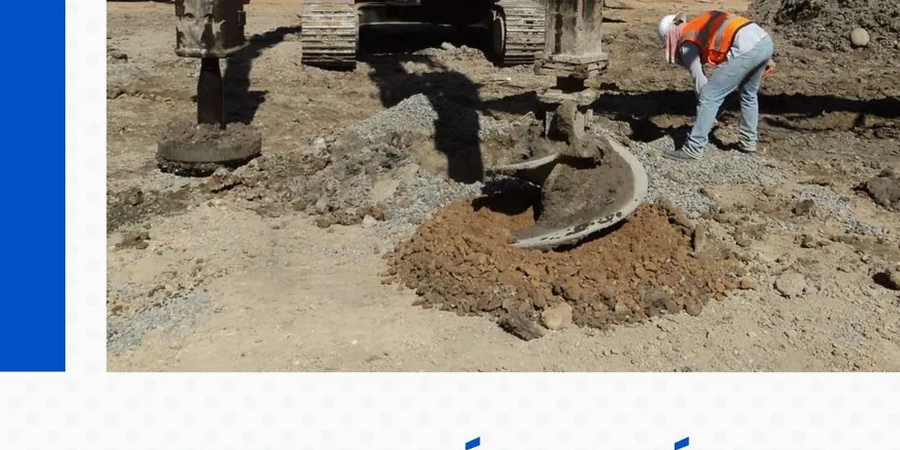
The equipment we mobilise for stone column design in Sunnyvale typically includes a high-frequency vibratory probe mounted on a 30-ton crane or a large excavator-based rig. The vibrator penetrates the soft ground, and we feed 1.5- to 3-inch crushed gravel through a side-feed system while the probe withdraws in controlled lifts. Each column is constructed in 1- to 2-foot increments, with the vibrator re-penetrating each lift to densify the stone. The result is a column typically 24 to 48 inches in diameter, spaced 5 to 9 feet on center. We verify the installed column quality with modulus tests using a plate load test on the top of selected columns, checking that the target stiffness of 10 to 15 MPa is achieved. The entire process is monitored with an automated data acquisition system that logs depth, amperage, and time for every lift, so we can certify the as-built condition against the design assumptions.
Technical reference image — Sunnyvale
Regional considerations
The primary geotechnical risk in Sunnyvale is the presence of soft, compressible clay and silt layers that extend from about 8 to 30 feet below grade, interbedded with loose sand lenses. These materials have undrained shear strengths often in the 300 to 600 psf range and can exhibit significant creep settlement under sustained loads. On top of that, the shallow groundwater table fluctuates seasonally but rarely drops below 12 feet, which means construction dewatering or displacement methods must account for perched water. Stone column design directly addresses these risks by providing drainage paths that accelerate consolidation and by creating stiff composite ground that reduces total and differential settlements. We have seen cases where a well-designed stone column grid cut the post-construction settlement from 4 inches down to under 1.5 inches on a 20,000 sq ft warehouse slab.
We develop the full column geometry — diameter, spacing, depth, and replacement ratio — based on site-specific CPT and SPT data. Our design reports include settlement analysis, bearing capacity checks, and construction specifications tailored to the local soils.
02
Field Verification & Modulus Testing
After installation, we perform plate load tests on selected columns to verify that the achieved column modulus matches the design value. We also conduct post-treatment CPT soundings to confirm the improvement in soil stiffness and to document the as-built condition.
Standards that apply
ASCE 7-22 (Minimum Design Loads and Associated Criteria for Buildings), IBC 2021 (International Building Code, Chapter 18 — Soils and Foundations), ASTM D1586-18 (Standard Test Method for Standard Penetration Test)
Top questions
How does stone column design work in Sunnyvale's soft soils?
Stone columns act as stiff vertical inclusions that reinforce the soft alluvial clays and silts. The gravel columns carry a higher proportion of the load, reduce total settlements by 40 to 60 percent, and accelerate pore-water dissipation thanks to their high permeability. The design is based on the replacement ratio, column modulus, and the native soil's undrained shear strength.
What is the typical cost of stone column design in Sunnyvale?
The cost for a complete stone column design package — including site investigation, numerical analysis, and a construction-ready report — typically ranges between US$1,580 and US$5,610. The final price depends on the site area, number of column load tests, and the complexity of the soil profile.
What building codes apply to stone column design in Sunnyvale?
Stone column design in Sunnyvale must comply with the 2021 International Building Code (IBC), specifically Chapter 18 for foundation systems, and ASCE 7-22 for load combinations and seismic considerations. Our designs also follow ASTM D1586 for SPT procedures and ASTM D2487 for soil classification.
How long does a stone column design study take?
A typical stone column design study for a Sunnyvale commercial or residential project takes 3 to 5 business days after receiving the geotechnical investigation data. If we also conduct the field exploration, the full process — from drilling to final report — takes 2 to 3 weeks.