Sunnyvale sits on a thick sequence of Holocene alluvium and bay muds that can exceed 30 m in depth, with groundwater typically encountered between 1.5 and 3 m below grade. For heavy industrial or multi-story projects, the required bearing pressures often surpass the capacity of untreated soft clays. Deep Soil Mixing (DSM) design in Sunnyvale allows us to create stiff, low-permeability columns that transfer loads to deeper strata while also mitigating liquefaction risks in loose sands. Before specifying a DSM pattern, we run a plate load test to calibrate the target Young's modulus and confirm the column-soil composite stiffness meets settlement limits.
Binder hydration in Sunnyvale's bay muds requires a lower water-to-cement ratio than typical alluvial clays to avoid strength regression.
Method and coverage
A common mistake we see is assuming a uniform column diameter and strength across the entire site without accounting for lateral variability in the clay and silt layers. In Sunnyvale, the presence of discontinuous sand lenses and variable moisture content directly affects the binder hydration and final unconfined compressive strength. Our DSM design in Sunnyvale includes:
Wet-grab sampling every 1.5 m during mixing to verify binder distribution;
Laboratory curing and UCS testing at 7, 14, and 28 days per ASTM D1633;
Calibration of the water-to-binder ratio based on in-situ groundwater chemistry analysis.
We tie each strength target to a specific area coverage ratio, which we validate with a CPT test to capture the actual soil stratigraphy before full-scale production.
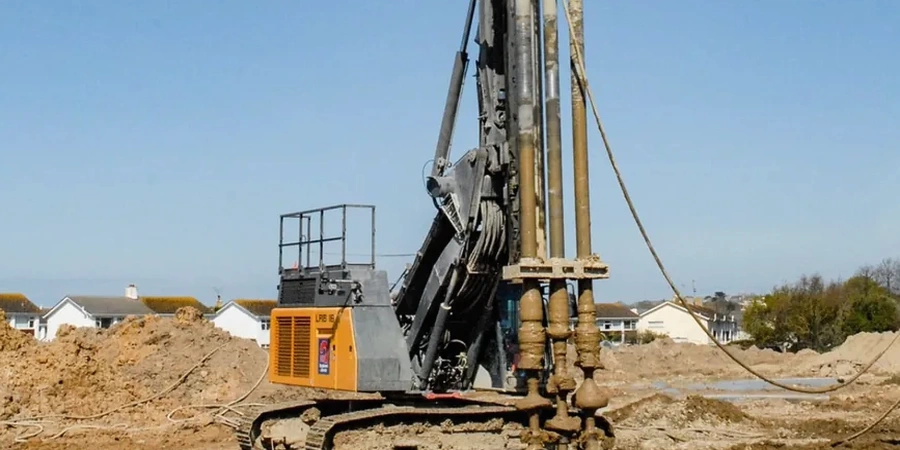
Technical reference image — Sunnyvale
Regional considerations
Sunnyvale urbanized rapidly after the 1950s, with many residential and commercial districts built directly on undocumented fills and soft estuarine deposits. The 1989 Loma Prieta earthquake triggered widespread liquefaction in similar Bay Area soils, a clear reminder of the vulnerability of untreated ground. A proper DSM design in Sunnyvale must account for the cyclic strength degradation of the treated columns under seismic loading, especially where the water table is high and fines content exceeds 70%. We incorporate the NCEER (Youd-Idriss, 2001) criteria to evaluate the post-treatment cyclic resistance ratio and ensure the improved ground meets IBC 2018 requirements for site class D or E.
Design of DSM grids to reduce liquefaction potential in loose sandy layers, targeting a post-treatment SPT N-value above 30 blows/ft and a cyclic resistance ratio (CRR) exceeding the design earthquake demand.
02
Foundation Support Columns
Column layout optimization for bearing capacities up to 300 kPa, including settlement analysis under service loads and verification via full-scale load tests.
03
Cut-off Wall & Seepage Control
Continuous DSM walls for excavation dewatering control and lateral groundwater barriers, designed with a maximum hydraulic conductivity of 1×10⁻⁷ m/s.
What is the typical unconfined compressive strength of DSM columns in Sunnyvale?
For Sunnyvale's bay muds and alluvium, we design for a 28-day UCS between 1.0 and 3.5 MPa, depending on binder type (CEM I 42.5R or slag-blended) and water content. Laboratory trials on site-specific samples are mandatory to confirm the target strength.
How much does a DSM design study cost in Sunnyvale?
The cost for a full DSM design study, including laboratory mix design, column layout, and settlement analysis, typically ranges between US$1,700 and US$5,390. Final pricing depends on the number of mixing trials and the complexity of the stratigraphy.
What depth can DSM columns reach in Sunnyvale's soils?
We routinely design columns to depths between 5 and 25 meters using single-auger or dual-auger systems. The maximum depth is controlled by the equipment torque capacity and the presence of dense gravel layers, which are uncommon in Sunnyvale's alluvial sequence.