A commercial development along Mathilda Avenue near the Caltrain corridor recently required foundation design for a six-story structure over deep alluvial deposits common to Sunnyvale. The geotechnical team specified a Ménard pressuremeter test (PMT) to obtain the deformation modulus (EM) and limit pressure (pL) directly in the borehole, parameters that SPT N-values cannot reliably provide for stiff clays and dense sands at depth. Before the PMT, the team completed an ensayo SPT to correlate refusal layers, then used the PMT probe to measure the stress-strain curve at three-meter intervals. The resulting modulus values allowed the structural engineer to optimize mat foundation thickness under ASCE 7 serviceability limits. Sunnyvale’s variable Quaternary alluvium makes this pressuremeter approach particularly useful for avoiding over-conservative designs that would increase concrete volumes unnecessarily.
The pressuremeter test measures soil stiffness at depth under controlled radial expansion, giving engineers a direct deformation modulus for settlement calculations.
Method and coverage
A recurring mistake in Sunnyvale projects is relying solely on SPT blow counts to estimate settlement in the stiff to very stiff clays underlying the city. The Ménard pressuremeter test captures the actual in-situ horizontal stiffness, which governs lateral response of deep foundations and the immediate settlement of footings. The PMT procedure follows ASTM D4719: a cylindrical probe is expanded in a pre-drilled hole while recording volume change versus applied pressure. Key parameters include the creep pressure (pf), the limit pressure (pL), and the pressuremeter modulus (EM). For Sunnyvale’s typical clay layers with undrained shear strength between 50 and 100 kPa, the EM/pL ratio often ranges 5–12, values that can be integrated directly into settlement analyses per IBC Chapter 18. The test also detects stress-relief effects in overconsolidated deposits. We complement the PMT with a dilatometer test when continuous stiffness profiles are needed across multiple strata.
Technical reference image — Sunnyvale
Regional considerations
In Sunnyvale, many geotechnical reports still estimate foundation settlement using empirical SPT correlations that were developed for different soil profiles. The risk is twofold: the compressibility of the stiff clay is underestimated, leading to differential settlement in buildings with irregular column loads, or the foundation is over-designed, driving up costs. The Ménard pressuremeter test directly measures the soil’s stress-strain response, eliminating the need for uncertain modulus correlations. When PMT results are combined with laboratory oedometer tests on undisturbed samples, the settlement prediction becomes significantly more reliable. For Sunnyvale’s deep alluvial basin, where groundwater sits at 3–4 m depth, the pressuremeter also captures the effect of partial saturation on stiffness near the water table, a condition that triaxial tests cannot replicate in the lab.
EM (pressuremeter modulus), pL (limit pressure), pf (creep pressure)
Test depth range
1.5 m to 30 m below ground surface in Sunnyvale alluvium
Load increments
11 equal pressure steps per cycle per ASTM D4719
Standard correlation
EM/pL ratio 5–12 for Sunnyvale clay; pL used for bearing capacity per IBC Eq. 18-1
Typical test duration
20–30 minutes per test level including probe inflation and data logging
Related services
01
PMT Field Execution – Sunnyvale Alluvium
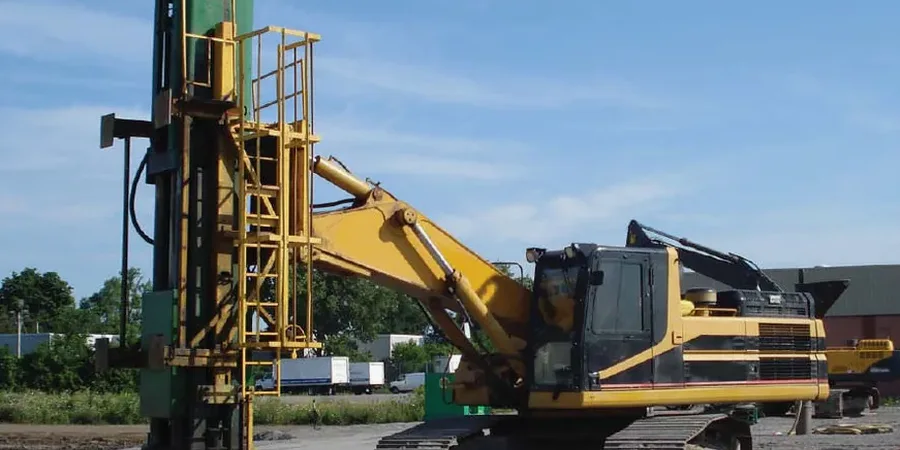
Our crew mobilizes a track-mounted drill rig to advance a 75 mm borehole using hollow-stem augers to minimize disturbance. The Ménard probe is lowered to the target depth, and the pressuremeter test is conducted at 1.5 m intervals or at strata changes. Data is recorded in real time with a digital pressure-volume controller. We provide the raw pressure-volume curves plus calculated EM and pL values for each level.
02
PMT Interpretation & Foundation Design Parameters
The raw data is processed to derive the net limit pressure (pL*), the creep pressure (pf), and the pressuremeter modulus (EM). Using the Menard empirical correlations and IBC 2021 criteria, we convert these values into allowable bearing capacity for spread footings and modulus of subgrade reaction for mat foundations. A final report includes the PMT log, tabulated results, and recommended design values for the Sunnyvale site.
Standards that apply
ASTM D4719-20 – Standard Test Methods for Prebored Pressuremeter Testing in Soils, IBC 2021 Chapter 18 – Soils and Foundations (allowable pressure from limit pressure), ASCE 7-22 – Minimum Design Loads and Commentary (serviceability limits for mat foundations)
Top questions
How does the Ménard pressuremeter test differ from a standard SPT in Sunnyvale's soils?
The SPT measures dynamic penetration resistance (N-value) which correlates indirectly to strength and stiffness. The PMT measures static radial expansion under controlled pressure, giving direct values of deformation modulus (EM) and limit pressure (pL). In Sunnyvale's stiff clays and dense sands, the PMT provides a more reliable modulus for settlement analysis, while the SPT remains useful for liquefaction screening and relative density estimates. The two tests complement each other: SPT first for profiling, then PMT at critical depths for design parameters.
What is the typical cost range for a Ménard pressuremeter test in Sunnyvale?
For a standard project requiring 6 to 10 test levels across 2 to 3 boreholes, the all-inclusive cost ranges between US$1,070 and US$1,200 per test level. This covers mobilization, borehole drilling, probe calibration, field execution, data reduction, and a final report with design parameters. Larger volumes or multi-site programs may reduce the per-test cost. Contact us for a detailed quote based on your specific depth and number of tests.
At what depths should the PMT be performed in Sunnyvale's alluvial profile?
The PMT is most effective when placed at the depth of the critical bearing stratum or at the base of planned deep foundations. For typical Sunnyvale sites with 3–4 m of fill over stiff clay, tests at 5 m, 8 m, and 12 m below grade capture the main foundation influence zone. The probe can reach up to 30 m, useful for evaluating deeper sand layers where pile tip resistance governs. Always correlate with the soil boring log to place tests in representative strata.
Can the PMT results be used for seismic site response analysis in Sunnyvale?
Yes, but indirectly. The PMT provides static modulus (EM), which can be converted to small-strain shear modulus (Gmax) using empirical correlations (Gmax ≈ 10–15 × EM for clay). For seismic site class per ASCE 7, the preferred method is VS30 from MASW or crosshole seismic tests. However, the PMT's limit pressure (pL) is directly used in IBC 2021 for bearing capacity under seismic loads, as it captures the soil's ultimate resistance under rapid loading conditions. We recommend combining PMT with MASW-VS30 for a complete earthquake response assessment.