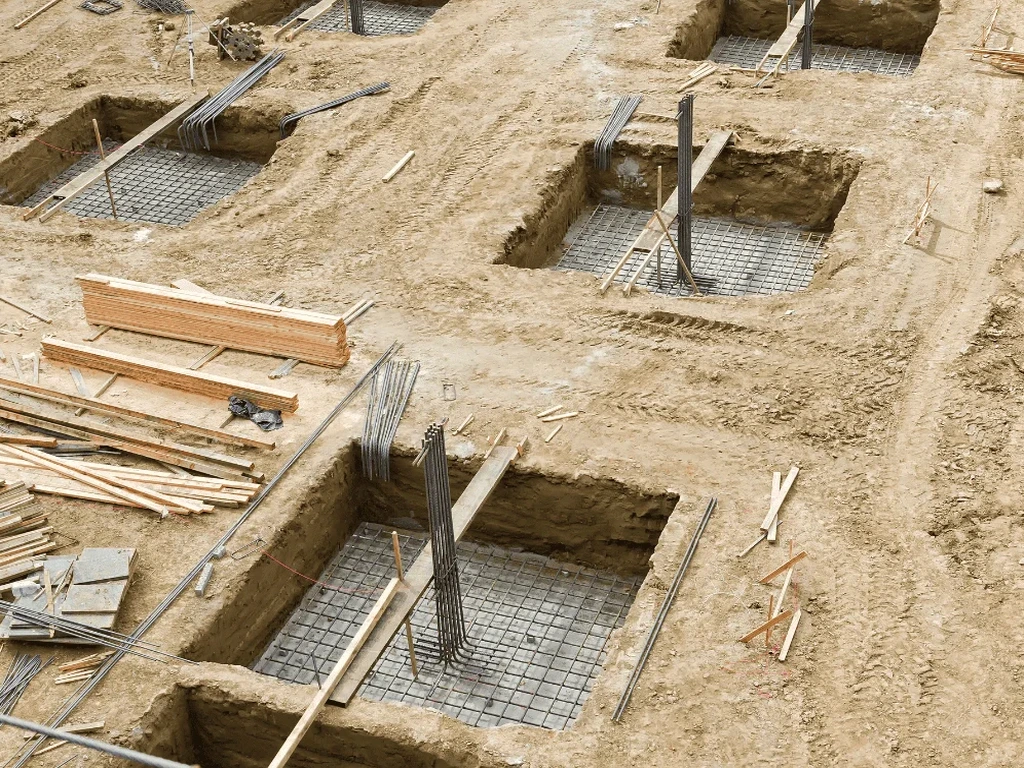
Sunnyvale grew fast after the 1950s, turning former orchards into a dense tech corridor built on alluvial fans and old bay mud. That flat, sandy fill over stiff clay means the seismic response varies block by block. Before we recommend a footing depth or slab reinforcement, we run a full shear-wave velocity profile to classify the site per ASCE 7 site class. Soil conditions here can shift from loose sands to stiff clays within 10 meters, so a generic approach won't work. Our team combines local borehole logs with a surface wave survey to define the Vs30 profile accurately, then cross-checks it against the MASW-Vs30 survey data we collected on adjacent parcels.
In Sunnyvale, the shallow water table and interbedded loose sands make site-specific Vs30 and CPT data essential for reliable seismic foundation design.
Method and coverage
One thing we see often in Sunnyvale is that the water table sits shallow, sometimes just 2 meters down, and loose sands below that depth are prone to liquefaction during a major quake. For seismic foundation design we need more than standard SPT N-values, so we pair the drilling logs with a CPT test to get continuous tip resistance and friction ratio. That lets us identify thin liquefiable layers that a split-spoon sample would miss. We also run cyclic triaxial tests on undisturbed samples to measure the pore pressure buildup under seismic loading. The final design parameters include the site class, allowable bearing capacity under dynamic conditions, and the estimated permanent settlement after the design earthquake.
Technical reference image — Sunnyvale
Regional considerations
A three-story office building near Mathilda Avenue had its slab-on-grade crack after the 1989 Loma Prieta earthquake because the underlying loose sand densified unevenly. That case taught us that seismic foundation design in Sunnyvale must account for both liquefaction and differential settlement. Without site-specific cyclic strength data, the foundation may rotate or settle non-uniformly. We also evaluate the risk of lateral spreading near creeks like Calabazas, where the soil can displace horizontally during shaking. Our reports flag those zones and recommend Improvement if the safety factor falls below 1.2.
Surface wave array (MASW) and borehole suspension logging to determine shear-wave velocity to 30 m depth. Results classify the site per ASCE 7 and provide input for ground response analysis.
02
Cyclic Triaxial Testing
Undisturbed samples tested under cyclic loading to measure pore pressure generation, cyclic strength, and post-cyclic deformation. Data used for liquefaction triggering evaluation and settlement estimates.
03
Liquefaction Hazard Assessment
Combined SPT and CPT-based methods (Youd-Idriss 2001, Robertson-Wride) to calculate factor of safety against liquefaction for multiple earthquake magnitudes. Includes lateral spread displacement estimates.
04
Dynamic Bearing Capacity Analysis
Finite element modeling using site-specific soil profiles to compute allowable bearing pressure under seismic loading. Considers strength loss due to cyclic softening and partial drainage.
Standards that apply
ASCE 7-22 (Minimum Design Loads for Buildings and Other Structures), IBC 2021 (International Building Code, Chapter 18), ASTM D1586-18 (Standard Test Method for SPT), ASTM D2487-17 (Standard Practice for Classification of Soils for Engineering Purposes)
Top questions
What is the role of Vs30 in seismic foundation design for Sunnyvale?
Vs30 classifies the site into ASCE 7 categories A through F, which directly control the design response spectrum. In Sunnyvale, typical values fall in Site Class D (180–360 m/s), so a measured Vs30 avoids over-conservatism and reduces foundation costs.
How much does a seismic foundation design study cost in Sunnyvale?
The typical range for a complete study including field work, lab testing, and a design report is between US$1,300 and US$4,150. The exact cost depends on the number of borings, the need for CPT or MASW, and the complexity of the soil profile.
Which soil layers in Sunnyvale are most prone to liquefaction?
Loose, clean sands below the water table, especially those with SPT N-values below 10 and fines content under 15%, are the most susceptible. These layers often appear between 2 m and 8 m depth in the alluvial deposits along El Camino Real and near Calabazas Creek.
Can seismic foundation design reduce foundation thickness compared to a conventional design?
Yes, if the site-specific analysis shows lower spectral accelerations or higher cyclic strengths than the code-default values. A measured Vs30 and site-specific amplification factor often allow a thinner mat or smaller footings than a generic Site Class D assumption.