Sunnyvale sits at an elevation of about 130 feet within the Santa Clara Valley, where the alluvial fan deposits from the Santa Cruz Mountains create a mix of silty sands, gravels, and clay lenses. For any MSE wall design in Sunnyvale, understanding that variability is key — we routinely test backfill materials to ensure they meet AASHTO M 145 classification and compaction requirements. Before specifying reinforcement, we run Atterberg limits on fines to confirm plasticity is low enough to avoid drainage issues, and we cross-check gradation curves against the pullout resistance models used in design. The local groundwater table sits relatively deep in most areas, but seasonal fluctuations can still affect the reinforced zone if not accounted for properly.
A successful MSE wall in Sunnyvale depends on verifying backfill compaction and interface shear strength before the first geogrid layer goes down.
Method and coverage
Sunnyvale's development boom from the 1960s onward turned former orchards into tech campuses and residential subdivisions, which means many MSE walls now support grade changes on sites with undocumented fill or remnant drainage channels. Over the years, we've seen design teams push for steeper face angles to maximize usable lot area, which demands tighter control on reinforcement type and spacing. In our experience, the biggest difference between a successful wall and one that develops bulging or settlement is the quality control program during backfill placement. That's why we always recommend complementing the MSE wall design with a dynamic cone penetrometer test program to verify compaction density every two feet of lift. We also use the same test pits to collect undisturbed samples for direct shear testing on the soil-reinforcement interface, which feeds directly into the internal stability calculations per FHWA-NHI-10-024.
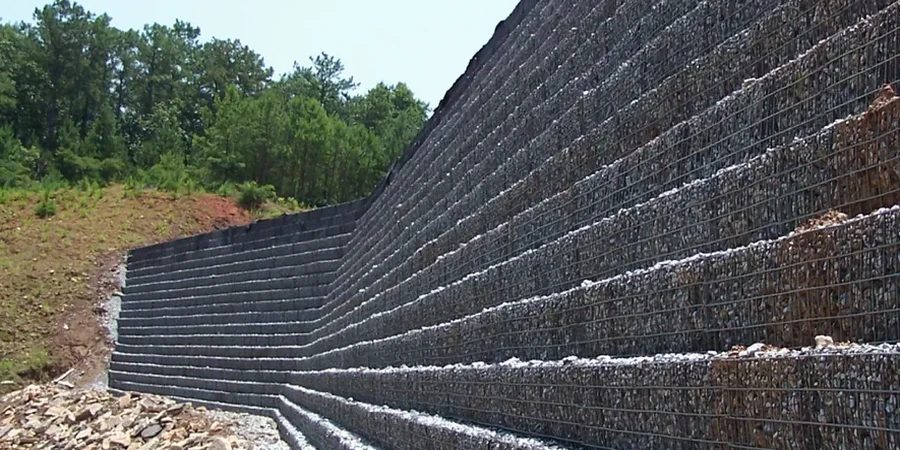
Technical reference image — Sunnyvale
Regional considerations
ASCE 7-16 classifies Sunnyvale in Seismic Design Category D, which means MSE wall design must account for peak ground accelerations up to 0.6g under the Maximum Considered Earthquake. The primary risk in the alluvial soils here is lateral spreading during a seismic event — the loose sandy layers can lose shear strength and pull the reinforcement out of the anchorage zone. We always run liquefaction triggering analysis using the NCEER (Youd-Idriss 2001) methodology on borings deeper than 50 feet to identify those critical strata. If the factor of safety falls below 1.1, we shift to a longer reinforcement length or include a drainage blanket behind the wall face to prevent pore pressure buildup during shaking.
We classify materials per AASHTO M 145, perform Proctor compaction (ASTM D698), and run direct shear tests on soil-geogrid interfaces using ASTM D6706 to provide pullout resistance parameters for design.
02
Seismic and Liquefaction Assessment
Using SPT-based methods (Youd-Idriss 2001) and cyclic triaxial testing (ASTM D3999), we evaluate liquefaction potential and provide recommendations for reinforcement length and drainage behind MSE walls.
03
Field Verification and Compaction Control
During construction, we perform in-situ density tests using a sand cone or nuclear gauge every two feet of lift, ensuring the backfill meets the 95% minimum compaction specified in the project plans.
What soil types are suitable for MSE wall backfill in Sunnyvale?
Granular soils classified as GW, GP, SW, or SP per AASHTO M 145 work best. Fines should be below 15% passing the No. 200 sieve, and plasticity index must stay under 6 to avoid drainage and strength problems. Silty sands common in Sunnyvale's alluvial deposits often meet these criteria with minor blending.
How does seismic design affect MSE wall construction in Sunnyvale?
Sunnyvale's Seismic Design Category D requires designers to check for liquefaction in loose sand lenses and to extend reinforcement lengths beyond the active wedge so the wall remains stable during peak ground accelerations up to 0.6g. We run SPT-based liquefaction analyses to identify critical zones.
What is the typical cost range for an MSE wall design and testing package in Sunnyvale?
For a standard wall between 10 and 20 feet tall, including backfill characterization, pullout testing, and construction compaction control, the total package typically runs between US$1.340 and US$4.390. The final cost depends on the number of test locations and reinforcement type.
How long does the compaction verification process take during construction?
For each lift layer, we perform two density tests per 1,000 square feet of backfill — each test takes about 15 minutes with a nuclear gauge. A typical 15-foot wall with 5 lifts can be verified in two to three days, provided the contractor places material at the right moisture content.