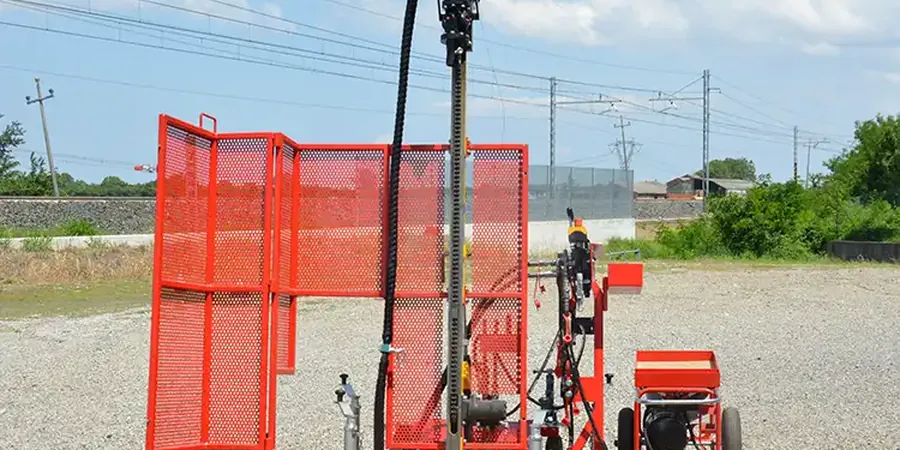
Sunnyvale's alluvial geology differs markedly between the older, more consolidated terraces near the Cupertino border and the young, loose Holocene deposits closer to the Guadalupe Slough. In the western neighborhoods, you might encounter stiff clays and dense sands requiring minimal compaction, while near the bay the same depth can yield loose silty sands with N-values below 10. This contrast makes the Standard Penetration Test (SPT) indispensable for site-specific characterization, because relying on a single boring from across town can lead to costly misjudgments. For projects where continuous profiling is preferred, coupling SPT with a cone penetration test provides complementary data on stratigraphy and pore pressure response. The SPT hammer energy must be calibrated per ASTM D1586-18 to ensure repeatable N-values, especially when correlating to relative density or friction angle for shallow foundation design.
Sunnyvale's alluvial variability demands site-specific SPT: one boring can show dense gravels while 50 m away loose sands control foundation design.
Method and coverage
Following ASTM D1586-18 and ASCE 7-22 guidelines, the SPT in Sunnyvale is performed using a 63.5 kg hammer dropped 760 mm to drive a standard split-spoon sampler. The blow count (N-value) is recorded over three 150 mm intervals, and the sum of the last two gives the penetration resistance. Because Sunnyvale sits within a seismically active region (NEHRP site class D to E), the uncorrected N-values are adjusted for overburden pressure and hammer efficiency to compute (N1)60, which feeds directly into liquefaction triggering evaluations per Youd-Idriss (2001). The recovered soil samples also undergo visual-manual classification and, when needed, laboratory tests such as grain size analysis to confirm soil type. Key parameters derived from SPT include:
Relative density for sands
Undrained shear strength for clays (via correlations)
Modulus of subgrade reaction (k-value)
Liquefaction potential index (LPI)
For projects requiring undisturbed samples, the SPT can be alternated with thin-walled tube sampling at selected depths to obtain specimens for triaxial or consolidation testing.
Technical reference image — Sunnyvale
Regional considerations
A common mistake among developers in Sunnyvale is assuming that a single SPT boring near the property line represents the entire lot. In reality, the transition from old alluvial fan deposits near El Camino Real to younger bay muds west of Mathilda Avenue can occur within meters. If the contractor relies on N-values from the boring at the edge and ignores the softer zone under the building footprint, differential settlements may exceed 25 mm, cracking slabs and tilting walls. The Standard Penetration Test (SPT) must be spaced adaptively — closer in areas of expected variability — and the N-values corrected for fines content when evaluating liquefaction under IBC seismic loads. Skipping this step has led to retrofitting costs that far exceed the initial geotechnical investigation.
SPT-based liquefaction triggering evaluation per Youd-Idriss (2001) and NCEER guidelines. We compute (N1)60-cs, factor of safety against liquefaction, and lateral spread displacement estimates for Sunnyvale's NEHRP site classes D and E.
02
Bearing Capacity & Settlement Analysis
Using corrected N-values to estimate allowable bearing capacity (Terzaghi, Meyerhof) and immediate settlement in sandy soils. Correlations to modulus of subgrade reaction for mat foundations and footings under ASCE 7 service loads.
Standards that apply
ASTM D1586-18 (Standard Test Method for SPT), ASCE 7-22 (Minimum Design Loads, Seismic site class), IBC 2021 (Chapter 18: Soils and Foundations)
Top questions
What is the difference between N-value and (N1)60 in the SPT?
The raw N-value is the blow count recorded in the field. (N1)60 corrects for overburden pressure (CN) and hammer energy efficiency (ERi/60) to produce a normalized resistance at 1 atm effective stress. In Sunnyvale's variable alluvium, using (N1)60 is critical for liquefaction evaluations and consistent correlations with relative density.
How deep should SPT borings go in Sunnyvale for a typical three-story building?
For a lightly loaded structure on spread footings, borings should extend at least 1.5 times the footing width below the bearing level, or to refusal in dense strata. In Sunnyvale's deep alluvium, 15 to 25 m (50 to 80 ft) is common to capture the full soil profile and assess liquefaction potential down to the highest water table.
Does the SPT work well in Sunnyvale's gravelly layers?
The split spoon can jam or break in coarse gravel, producing falsely high N-values. When cobbles or boulders are encountered near the surface, we recommend alternating SPT with test pits or using a larger-diameter sampler. For deeper gravels, the SPT can still provide useful refusal data if the N-value exceeds 50 blows per 150 mm.